Protecting Your Assets during Divorce in Cary
 Google Reviews

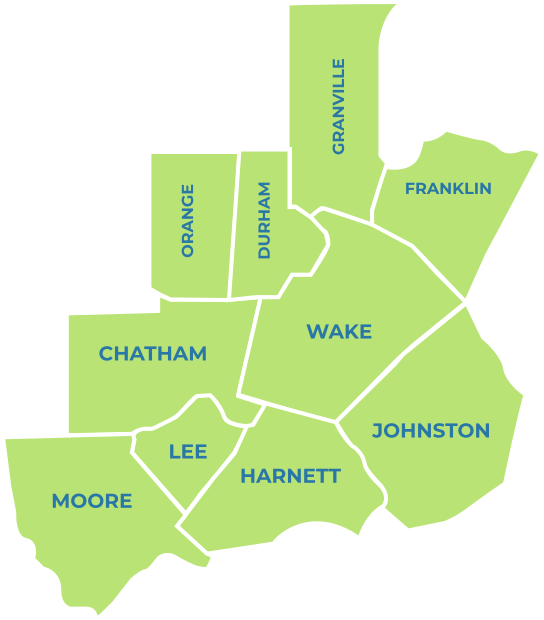
Divorce Asset Division Attorneys Serving Chatham, Cumberland, Durham, Franklin, Granville, Harnett, Johnston, Lee, Moore, Orange & Wake Counties
Divorce asset division can be one of the most difficult and contentious parts of the divorce process. Both you and your spouse may feel entitled to the assets, such as the house, the cars, or even retirement accounts, you have accumulated throughout your marriage. Unfortunately, dividing assets does not always turn out to be as easy as you might have thought. A Cary divorce asset division attorney can help you learn more about your rights, how to divide your assets, and equitable asset division.
What Is Equitable Distribution?
In North Carolina, the process of dividing your property is referred to as equitable distribution of marital and divisible assets. That does not necessarily mean that every asset will be divided precisely down the middle, but that you must decide how to fairly separate your assets. What is “fair” might not be equal. If you and your former spouse cannot arrive at an agreement regarding asset distribution on your own–including when working with an attorney or a mediator to help you discuss your concerns and understand your rights–the Court will make a decision on an equitable division of your assets.
At Triangle Smart Divorce, we believe in our clients participating in the decision making process as much as possible. Our first choice is always going to be seeing if you and your spouse can work it out without the Court’s involvement, though we know that is just not possible in some cases. In those situations, we take our decades of experience and fight for an equitable division in Court.
Types Of Property Considered In Divorce
In order to divide your property equitably in a divorce, the Court will take a look at four distinct types of assets. Divorce asset division requires a reasonable understanding of the four types of property and how they apply to your divorce and your assets.
Separate Property
Separate property is any property that belongs to just one spouse. If you truly have separate property, it will not be part of divorce asset division. Separate property might include:
- Property that belonged to one spouse before the marriage
- Property acquired during the marriage due to an inheritance left to one spouse
- Property acquired via a gift from a third party to one spouse
- Property gifted from one spouse to the other, when the gift was designated separate property at the time of the gift
- Income from some types of separate property, like rental property, owned by one spouse prior to the marriage
Marital Property
Marital property is often the largest point of contention during divorce asset division. Marital property includes all the property that was acquired during your marriage, other than property already included under separate property for one of the reasons described above. Marital property may include:
- Property specifically purchased during the marriage, including vehicles, homes, and income-generating properties
- Retirement assets and benefits
- Pension benefits
- Gifts between spouses unless a contrary intent was expressed at the time of the gift
- Income generated during the marriage by either party, unless protected under separate property
Marital property is subject to the equitable division of assets under North Carolina divorce law. Dividing assets equitably can involve a considerable battle between spouses, especially if both spouses want to hold on to particular assets.
Divisible Property
Divisible property includes assets that were acquired, or that increased in value, following the date of separation and before the effective date of equitable distribution. For example, if you and your spouse owned rental property together, you may need to arrive at an agreement that will help divide income from those properties from the point of separation until the point of equitable distribution. Another example of divisible property is market changes to investment accounts, retirement accounts, or real property. Divisible property is subject to divorce asset division in much the same way as marital property.
Mixed Property
Mixed property occurs when an asset has characteristics of at least two types of property, such as separate and marital components. A classic example of mixed property is a 401(k) which was started before marriage but has grown by both contributions during marriage and market changes. Efforts must be taken to determine what part is marital, what part is separate, and even what part is divisible. The marital and divisible components are subject to equitable distribution, and the separate component should be excluded.
How Are Assets Divided In North Carolina?
If possible, you and your spouse may want to try to work out a division of your assets outside of Court. If you cannot manage your asset division on your own, mediation is an option. If you cannot reach an agreement, a Judge will determine the equitable distribution of marital and divisible assets. In deciding if equal is equitable, the Court may consider:
- What property you own
- What debts you have
- The financial obligations of each spouse
- How long you were married
- What contributions you made to the marriage–both financially and in terms of other types of support.
- Retirement benefits obtained by each spouse
- Financial efforts made by each spouse, including what efforts were made to obtain and protect property or whether one spouse was more likely to waste marital assets
- The contributions one spouse made to the education and overall support of the other
- Contributions made to any jointly-owned businesses
Each divorce case is highly individual, and asset division is going to look different based on your unique marriage, assets, and financial situation.
Finding The Best Cary Divorce Asset Division Lawyer For You
Attorneys play a crucial role in the asset division process during a divorce. Like with all cases, we help our clients navigate the legal system, and we work to ensure that our clients’ rights and interests are protected throughout the process. One of the main responsibilities we have as North Carolina divorce attorneys is to help our clients understand the laws and regulations that govern the division of assets. This includes understanding the different types of assets that are subject to division, such as property, investments, and retirement accounts. We also ensure our clients understand the legal process for dividing assets, such as the requirements for property valuations and the procedures for dividing retirement accounts.
If you are struggling with divorce asset division, having the right Cary divorce asset division lawyer is critical to ensuring your success. Triangle Smart Divorce has ample experience with divorce asset division, and more importantly, understands how important asset division is to you and your future. Contact us today to schedule a call.
FILL OUT THE FORM BELOW AND WE WILL CALL YOU
Agreement Section 1
Agreement Section 1






What our clients say
"Across three states, Jenny was hands-down the best divorce lawyer I worked with! Authentic, savvy, insightful, tough, empathetic and effective. Can ’t say enough good things about her."

"The entire staff at Triangle Smart Divorce has been wonderful. My divorce has been extremely complicated and difficult, they have helped and been successful at every turn. They are more than competent and are also very compassionate individuals. They will and do walk you through each and every step to obtain the best results for you. An amazing team!"
Meet Your Team
Our practice is entirely dedicated to helping couples move forward with confidence when dealing with divorce. You’re not alone.
Bradley
Bradley
LeFante
LeFante
Seagroves
Seagroves
rothert
rothert
O’Malley
O’Malley
stuntebeck
stuntebeck
Fillippeli
Fillippeli
Kober
Kober
Hodgins
Hodgins
Lester
Lester
Marks
Marks
Gardner
Gardner
Miller
Miller
Gokey
Gokey
Gagnon
Gagnon
Eakes
Eakes
Allen
Allen
Caling
Caling
Rosario
Rosario
Cayford
Cayford
Douglas
Douglas
Bigger
Bigger
Hagler
Hagler
Roakes
Roakes
Hartsell
Hartsell
Carlsten
Carlsten
Cazarez
Cazarez
Gardner
Gardner
Peele-Garcia
Peele-Garcia
Learning center
Want to know how to prepare for divorce? Use our free resources to guide you. Our mission is to get you to where you want to be — without years of legal fees, court battles and emotional damage.




Blog
All Blogs



Resources
All ResourcesTop-Rated Divorce Lawyers
Serving the Triangle and surrounding counties for 25+ years
Wake County
RaleighApexGarnerFuquay-Varina Holly SpringsKnightdale Morrisville ZebulonWendellRolesvilleChatham County
ApexOrange County
Chapel HillDurham County
DurhamHarnett county
Lee county
Moore county
Franklin county
CHATHAM COUNTY
Johnston county
Not your typical divorce lawyers
We are here to help you succeed and protect what you value most.