Frequently Asked Questions
 Google Reviews

Frequently Asked Questions About Divorce and Custody in North Carolina
When it comes to something as pivotal as a divorce or separation, you might be feeling overwhelmed by all the things you don’t know, or letting it hold you back from taking the first step forward – even if you know it’s time for a change. Knowledge is often the key to confidence, so at Triangle Smart Divorce, we want to arm you with the insights you need to make smart decisions as you navigate this unfamiliar landscape.
Below we’ve answered some of the most frequently asked questions we receive from clients, but every case is unique! For personalized legal advice, we encourage you to reach out to our firm and request a consultation with our Team!
What if my spouse will not leave the house?
This is a difficult answer that depends on several circumstances, and, of course, the easiest way to start the seperation is for one of you to voluntarily move out of the marital home. However, we typically advise our clients not to move from the marital home without legal advice and a plan. If neither of you are willing to leave the home, then under a very few limited circumstances of significant bad acts by your spouse, you may be able to ask the Court for a “divorce from bed and board,” which is a Court Order requiring the bad actor to leave the home in favor of the innocent spouse. Unfortunately, when the marriage has become that bad, both spouses can claim (sometimes rightfully) the other committed bad acts which can cause a claim for a divorce from bed and board to be denied. The best way to know your rights and options based on your specific situation is to book a consultation with our Team. Otherwise, you risk dragging out your case unintentionally.
I want a divorce, but my spouse does not. What should I do?
Informing your spouse of your intentions to file for divorce can seem like an impossible task. In short, you’ll need to carefully plan what you want to say, and remember to prioritize compassion and respect for this person you’ve shared your life with, even if things get ugly. That said, you don’t need your spouse’s agreement to begin the legal process in North Carolina. If you are living separately and meet the state’s one-year separation requirement, you can move forward by filing—your spouse cannot prevent the divorce itself, even if they don’t want it. For more tips, check out this resource for approaching this delicate issue.
Can my spouse and I use the same divorce attorney?
Absolutely not. If you are in the process of separating or divorcing, you have competing interests with your spouse. That means that an attorney is prohibited by the North Carolina State Bar from representing both of you, including in the negotiation or preparation of a Separation Agreement. If your spouse presents you with a Separation Agreement or any other type of legal document, you should have your own attorney review it to ensure that you fully understand it and what impact it has on your future. You and your spouse can choose an attorney to serve as mediator in your case, but that mediator cannot draft the Separation Agreement for you either as that is in conflict with the mediator’s role as a neutral third party.
Do we really have to be separated for a year before we can get divorced?
Yes, to file for divorce in North Carolina, you must have lived separate and apart for one year, and one of you must have resided in North Carolina for at least six months prior to filing for divorce. In North Carolina, you must live in separate homes to be considered as living separate. Sleeping in separate beds and refraining from sexual contact does not meet the state’s definition of “separate and apart.” However, during that one year, you can resolve all the issues in your divorce - like custody, property and debt division, spousal support, and more - so that when the waiting period is up, you can proceed as quickly and swiftly as possible with ending your marriage. Our North Carolina divorce lawyers can help you make the most of your time by helping you reach fair, favorable solutions! Book a consultation today.
How is child support determined?
The North Carolina Child Support Guidelines offer a formula for determining the presumptive basic child support obligation for families whose combined adjusted gross income falls within a certain range (this threshold changes periodically, so make sure you speak with our North Carolina child support lawyers to ensure you have the most up-to-date information). These guidelines take into account factors such as work-related childcare expenses, health insurance premiums paid for the children, and whether either parent is financially responsible for supporting other children. However, if the parents’ combined income exceeds the specified threshold, the parents can either agree on child support outside of court or the court must hold a hearing to determine child support based on the specific facts and circumstances of the case. There are also circumstances other than high income in which a parent may request a deviation from the child support guidelines. One example of a reason to deviate may be when one parent pays 100% of the child support obligation and 100% of the insurance premium.
What does “equitable distribution” mean?
North Carolina uses the term “equitable distribution” to describe the process of equitably dividing the net marital and divisible estate (assets and debts) between two spouses who have separated or are beginning the process of divorce.
Can I get (or will I have to pay) alimony?
In North Carolina, alimony (and post separation support) is determined by agreement of the spouses or by the Court, and it is not applicable in all cases. If the issue of spousal support is in the Court system, a Judge must find that one spouse is a “dependent spouse” and the other spouse is a “supporting spouse” who has the ability to pay alimony. The Judge will then consider the statutory factors and other relevant circumstances to determine whether an award of alimony is equitable.
Do I have to go to Court?
Not necessarily. If there are disputes that you cannot resolve through compromise and agreement, then you will have to go to Court. However, provided you and your spouse (and your attorneys) can work everything out in agreements and such, then you may never have to go to the Courthouse, not even to get divorced.
Why do I have to supply so much personal & financial information?
Your attorney must have adequate information and documentation to support or defend legal claims asserted by you or your spouse and to investigate claims and allegations asserted by either of you. We understand that the volume of documents that are required in many cases can be overwhelming, especially if you are not very well organized. However, these documents are needed to help the attorney work with you to determine a strategy and a roadmap for your situation.
Do NC Courts distribute marital & divisible property equally?
There is a presumption that the net marital and divisible estate should be distributed equally between the spouses. However, equitably does not mean equal; it means fairly. As such, there are certain factors that the Court can consider in justifying an unequal division of marital property and debts. Additionally, if you and your spouse have agreed upon the division of your assets and debts, you may do so in a Separation Agreement and Property Settlement, which does not need the Court’s blessing or approval and which will remain private and not in the public record at the Courthouse.
Is my spouse entitled to receive any of my retirement or pension if we get divorced?
Any portion of your retirement account or pension plan that was acquired during the marriage is presumed to be marital property which is subject to division between you and your spouse as part of the equitable distribution process.
Do I have to have a lawyer?
You can get divorced in North Carolina without hiring or even speaking to a lawyer. However, talking with an experienced divorce attorney before you begin the separation or divorce process is in your best interest. An attorney can listen to the facts of your situation and give you expert, practical advice about your legal rights and options. In our experience, DIY divorces do not always address all the claims a person might have. Often what you save on the front end by handling it yourself is much less than the expense on the backend to undo the DIY divorce and fix mistakes, if it can be undone.
Why is the date my spouse and I separated important?
In North Carolina, you must be separated for one full year before you are eligible to file an action for absolute divorce. Therefore, the date of separation determines what the earliest date is that you can file for divorce. Additionally, all marital assets and debts must be valued as of your date of separation for purposes of equitable distribution; and support claims can be retroactive to the date of separation.
If a parent doesn't pay child support, can it prevent them from seeing the child?
No. Under North Carolina Law, child support and child custody are two separate legal issues. A parent’s failure or refusal to pay child support is not a basis for the other parent to deny access to the child. If you’re in one of these situations (being denied visitation or not receiving your court-ordered child support) our skilled North Carolina child support lawyers can help - book a consultation today.
How is child custody determined under North Carolina Law?
Either by the parents’ agreement or by the judge. When parents cannot agree and a lawsuit is filed about custody and visitation, the parents must attend mandatory parenting classes and mediation. If the parents resolve custody at mediation, the Parenting Agreement is submitted for approval by a Judge and adopted as a Court Order. However, if the parties are unable to negotiate a custody agreement in mediation or outside of mediation, then the Court will decide for the parents. It's important to know you have options. You can pursue private mediation outside of court, which we recommend, as it often allows parents to reach an agreement on their own terms without involving the court system. But if you choose to go through the court process, court-ordered mediation is mandatory. And if you can’t reach an agreement during that court-mandated mediation, that’s when a judge will ultimately make the decision for you. Sometimes, temporary custody will be decided on less than two hours of evidence, which is why we encourage our clients to resolve custody by agreement if possible. North Carolina Judges determine custody by applying the standard of “the best interests of the child.” Who knows that better? The parents or the Judge? You’re probably thinking, “Me, duh!” We think so too. So, contact our office today to book a consultation and learn how our North Carolina custody lawyers can make that process as simple and empowering as possible.
What if we are separated but occasionally we've stayed at each other’s house?
Isolated incidents of sex between separated spouses does not stop the clock on the date of separation. However, if you resume your relationship, as determined by a totality of the circumstances, the date of separation will be determined by the date of your last separation.
What issues do I need resolved before I file for divorce?
The claim for divorce is only one claim that is triggered by your separation. These are the most common ones: child custody, child support, post-separation support/alimony, and equitable distribution (the division of assets and debts). These issues do not have to be resolved before the Court grants your divorce. They are separate legal issues that can be filed with the Court and heard by a Judge or resolved by agreement (private contract or Consent Order) at any time after separation. You do not have to wait the one-year period to deal with those claims. However, your legal claims for alimony and equitable distribution must be filed with the Court (not necessarily resolved) before the divorce is granted. Claims for child custody or child support can be filed at any time. Our North Carolina divorce lawyers can help you navigate this process with a focus on the future, rather than fighting and conflict - book your consultation today!
What is the difference between “legal custody” and “physical custody”?
Legal custody refers to a parent’s right to make decisions on behalf of a child, including decisions about health, education, and religious upbringing. The parents may have joint legal custody in which they must jointly make major child-related decisions together, or one parent may be awarded sole legal custody, which allows this parent alone to make major decisions on behalf of the child. Physical custody refers to where the child resides and how much time the child spends in the physical care of each parent.
Frequently Asked Questions About Prenups in North Carolina
Prenups have somewhat of a reputation, but most of the negativity that surrounds them is based on stigma rather than fact. The FACT is that prenups don’t exist just to protect one spouse, and they are NOT a sign of distrust between two partners; they are legal documents which help BOTH spouses get on the same page about their finances before the marriage begins.
Still, we understand why you might be hesitant to move forward with this process, especially if you still have questions about what prenups are, what they actually do, and how they work. So, we’ve compiled some of the most common questions we get from our clients. However, every relationship is unique – for personalized legal advice tailored to your specific situation, don’t hesitate to reach out and request a consultation with a member of our Team!
What if we already bought a house together before getting married?
Absolutely! This actually comes up more often than you'd think since so many couples are living together and making big purchases before tying the knot. A prenup can specify exactly how that house (and any other jointly-owned property) gets handled if you divorce. Maybe you want to split it 50-50, or maybe one person contributed more to the down payment and wants that reflected. You can also decide who gets to stay in the house, how to handle the mortgage, or whether it gets sold and the proceeds divided. The key is getting this stuff figured out now when you're both thinking clearly, not during a messy divorce when emotions are running high.
Can I write my own prenup?
The question really isn’t about whether you can, it’s about whether you should. DIY prenups are notorious for being thrown out in court because they miss important legal requirements or contain unenforceable language. Plus, you won't have the independent legal advice that courts look for when determining if the agreement was fair. Trust us, the money you might save upfront isn't worth the headache later. Book a consultation with our Team and let’s make sure you’re protected beyond the shadow of a doubt.
Can a prenuptial agreement address future inheritance?
Yes, a prenup can absolutely address how any future inheritances or gifts will be handled if the marriage ends in divorce. Typically, assets that are acquired before marriage or given as gifts during the marriage are considered separate property. But without a prenup, those assets could end up being considered marital property if they get mixed (commingled) with joint assets. A well-drafted prenup can make sure that any future inheritances or gifts are kept separate and protected from division if the marriage ends.
How can a prenup protect my retirement accounts or pension?
A prenup can specify how retirement accounts and pensions will be treated in the event of a divorce. Typically, contributions made before the marriage are considered separate property, but if the retirement account grows during the marriage, it could be considered marital property. A prenup can establish whether the entire account, or just the portion accumulated during the marriage, will be divided in divorce. Don’t risk losing the financial cushion you’ve worked tirelessly to build up! Book a consultation with our North Carolina prenuptial agreement lawyers today to learn how we can help you face the future with peace of mind.
Do prenups become void if one spouse passes away?
No, prenups don’t automatically become void if one spouse passes away. While they’re most commonly used in the event of a divorce, they can also outline how assets should be handled after death. This can be especially helpful if you have children from previous marriages or a unique family situation to make sure that everyone’s interests are clearly defined. For example, a prenup can specify that certain property or family heirlooms remain in one spouse’s family, even if the couple divorces or one spouse passes away. However, it’s important to note that prenups cannot override a will or trust, which must also be updated to reflect any changes the prenup may create.
Can a prenuptial agreement cover future income, like from a career growth?
Yes, a prenup can definitely address how future income will be handled if things don’t work out. This is especially useful for people who expect to see big financial growth down the line. For instance, if you own a business, you might want to make sure the value your business gains during the marriage stays separate property. Or, if you’re in a career where you expect your income to grow or have valuable intellectual property, you can protect that too in your prenup. Our North Carolina prenuptial agreement lawyers can help you make sure that what you earn in the future is clearly defined and protected! Book a consultation today to learn more about how we can streamline the process.
What makes a prenup legally invalid?
Common reasons prenups are challenged in court include: Lack of full disclosure Coercion or duress Lack of legal formalities Unconscionability (severely one-sided terms) Failure to meet state-specific requirements Inclusion of unenforceable provisions (such as child custody or support) Inadequate legal representation Not sure if your prenup will hold up in court? Contact our experienced North Carolina prenuptial agreement lawyers today to book your consultation and get a full review!
What can and cannot go into a prenup?
A prenup can cover asset division, spousal support (alimony), debts, property rights, inheritance rights, and other financial matters, depending on the couple’s specific needs and circumstances. However, child custody and support matters cannot be included.
Can a prenup protect my business or family inheritance?
Yes, a prenup can protect your business, family inheritance, and other separate assets that you want to remain yours in the event of a divorce! Our skilled team of North Carolina family lawyers can help tailor your prenup to your specific needs - book a consultation today
Can we modify or revoke a prenup after marriage?
Yes, a prenuptial agreement can be modified or revoked after marriage if both parties agree and sign a new contract, but it must be done in writing and with proper legal procedures.
Aren’t premarital agreements expensive?
The upfront costs of a premarital agreement are significantly less than the costs of a litigated divorce, an estate dispute, or even most amicable divorces. Additionally, debt, alimony, and assets divided up beforehand can save a lot of time and money in the case of divorce. A premarital agreement can also help you go into marriage with a little less stress on your shoulders. Stress has a cost, too. And, again, with a premarital agreement, you are making sure your financial matters are handled according to your wishes rather than what the state says. It is very expensive to undo what the state does.
When do I have this conversation?
Our advice is before you pick the venue, select the caterer, or even start the wedding planning process, have a conversation about premarital agreements. We have found that many of our clients delay because they feel uncomfortable bringing up the topic. We get that. We really do. But it was much more uncomfortable for our clients who had to reschedule the wedding the night before because the premarital agreement was still being negotiated. Or even more uncomfortable for the client who had to tell her friends and family that she was not getting married anymore because her debt-ridden soon-to-be spouse wanted her to be on the hook for his thousands of dollars of premarital debt. People underestimate the amount of time it takes to negotiate and prepare a premarital agreement, and the longer they delay, the more difficult and stressful it becomes. Who wants to be negotiating an agreement in the midst of making wedding plans, having engagement parties, and picking out the dress? NO ONE. Doing this can create feelings of unfairness for the other party, and if there is one thing we are clear on after decades of collective experience as divorce lawyers and mediators, it is that a perception of unfairness leads to unhappiness which leads to resentment. None of that is a good way to start a marriage.
Can a prenup protect against debt?
Yes! Agreements can be used to protect spouses from each other’s debts, both premarital and ones created during the marriage.
What makes a prenup legally invalid?
Common reasons prenups are challenged in court include: 1.Lack of full disclosure 2.Coercion or duress 3.Lack of legal formalities 4.Unconscionability (severely one-sided terms) 5.Failure to meet state-specific requirements 6.Inclusion of unenforceable provisions (such as child custody or support) 7.Inadequate legal representation Not sure if your prenup will hold up in court? Contact our experienced North Carolina prenuptial agreement lawyers today to book your consultation and get a full review!
Are prenups and postnups the same thing?
Simply put, prenups happen BEFORE you get married and postnups happen AFTER you get married. Both prenups and postnups can outline how marital assets, debts, inheritances, and more can be distributed in the event of divorce; however, the key difference between the two is that alimony and spousal support generally cannot be addressed in a postnup .
Why do I need a prenuptial agreement?
One of the first objections we hear is, “I cannot talk to her about a prenup. That makes it seem like I am expecting we won’t last.” Sounds like a legitimate objection, doesn’t it? But it neglects reality. Death is 100% and divorce is 40%. No one thinks twice about packing an umbrella if there’s a 100% chance of rain. Most people take a raincoat if there’s a 40% chance of rain. But so many people fail to have protections before getting married. Why? False beliefs and stigma, in our humble opinion. Stigma surrounding premarital agreements. False beliefs that they are only for the rich, only for someone who doesn’t think the marriage will work, or only for someone who doesn’t trust the other’s financial decisions. “B.S.,” we say.
Aren’t premarital agreements super easy to get out of?
This is an urban legend. So long as both people have informed the other of their assets (often called “disclosure”) and both people are acting voluntarily (meaning not drunk, not out of their mind, not having a gun to their head) then the premarital agreement will stand provided it is drafted properly. What this means is that you can plan how your finances will be dealt with at your death or divorce and not worry that a court can override the decisions you and your significant other made. It's critical to note that most prenups that are successfully challenged fail because they didn't adhere to specific state requirements, not because of disclosure or voluntariness issues. Each state has different legal standards for prenuptial agreements, and without proper legal guidance, even well-intentioned couples can create documents that don't meet these technical requirements. This is precisely why hiring an experienced family law attorney is essential - they make sure your agreement is properly executed according to your state's laws, dramatically increasing the likelihood it will be upheld if ever challenged. The relatively small investment in legal expertise upfront can prevent significant financial consequences later.
What happens if we don’t get a prenup?
The truth is you have an agreement whether you put one in writing or not. If you and your significant other do not create and tailor your own agreement to your specific situation, then you have an agreement that the laws of North Carolina will decide your division of assets upon death and divorce and those same laws will determine how much, if any, alimony you pay or receive. What’s better? Leaving the issues up to the government or deciding for yourselves how you will handle the issues upon death or divorce? A dose of reality: we will all die. We don’t know when. We don’t know how. But we know we will. Another dose of reality: a first marriage is 40% likely to end in divorce within 15 years according to the National Center for Health Statistics. The percentages go up as the number of marriages increase.These are the cold, hard facts . . .
FILL OUT THE FORM BELOW AND WE WILL CALL YOU
Agreement Section 1
Agreement Section 1






What our clients say
"Across three states, Jenny was hands-down the best divorce lawyer I worked with! Authentic, savvy, insightful, tough, empathetic and effective. Can ’t say enough good things about her."

"The entire staff at Triangle Smart Divorce has been wonderful. My divorce has been extremely complicated and difficult, they have helped and been successful at every turn. They are more than competent and are also very compassionate individuals. They will and do walk you through each and every step to obtain the best results for you. An amazing team!"
Meet Your Team
Our practice is entirely dedicated to helping couples move forward with confidence when dealing with divorce. You’re not alone.
Bradley
Bradley
LeFante
LeFante
Seagroves
Seagroves
rothert
rothert
O’Malley
O’Malley
stuntebeck
stuntebeck
Fillippeli
Fillippeli
Kober
Kober
Hodgins
Hodgins
Lester
Lester
Marks
Marks
Gardner
Gardner
Miller
Miller
Gokey
Gokey
Gagnon
Gagnon
Eakes
Eakes
Allen
Allen
Caling
Caling
Rosario
Rosario
Cayford
Cayford
Douglas
Douglas
Bigger
Bigger
Skelton
Skelton
Roakes
Roakes
Hartsell
Hartsell
Carlsten
Carlsten
Cazarez
Cazarez
Gardner
Gardner
Peele-Garcia
Peele-Garcia
Learning center
Want to know how to prepare for divorce? Use our free resources to guide you. Our mission is to get you to where you want to be — without years of legal fees, court battles and emotional damage.




Blog
All Blogs



Resources
All ResourcesTop-Rated Divorce Lawyers
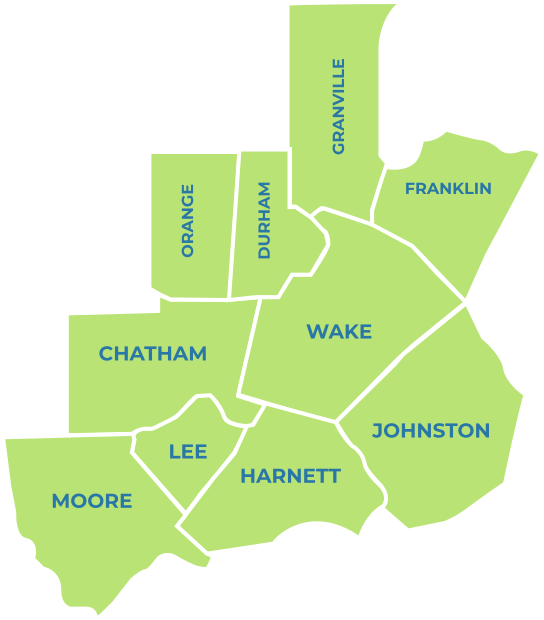
Serving the Triangle and surrounding counties for 25+ years
Wake County
RaleighApexGarnerFuquay-Varina Holly SpringsKnightdale Morrisville ZebulonWendellRolesvilleChatham County
ApexOrange County
Chapel HillDurham County
DurhamHarnett county
Lee county
Moore county
Franklin county
CHATHAM COUNTY
Johnston county
Not your typical divorce lawyers
We are here to help you succeed and protect what you value most.