Efland, NC Custody Lawyers
 Google Reviews

Efland, NC Custody Lawyers
Crafting a custody arrangement can be one of the most challenging aspects of divorce. Your children are at the heart of your concerns, and as your marriage comes to an end, their well-being and future become the top priority.
Grappling with your emotions and focusing on what’s best for your children simultaneously can be difficult, but it’s essential. Divorce impacts not only you and your spouse but also your children, who are about to face significant changes in their daily lives.
At Triangle Smart Divorce, we prioritize your children’s best interests in every decision we make in order to minimize the disruption caused by divorce and custody issues. If you need help creating a custody arrangement, call Triangle Smart Divorce today to request a consultation with one of our Efland custody lawyers and explore your options.
How Does Custody Work in North Carolina?
There are two types of custody in North Carolina: legal and physical. Legal custody refers to which parent has the right to make important decisions on behalf of their children when it comes to their healthcare, education, and religion. North Carolina family courts typically favor arrangements where both parents make these important decisions together. However, if one parent lives far away, is abusive, neglectful, or not a part of the children’s lives, a judge might grant sole legal custody.
Physical custody has to do with which parent the children reside with the majority of the time. Though the courts prefer shared physical custody, it’s important to note that even in a joint physical custody arrangement, the children’s time won’t necessarily be split 50-50 between two households.
Visitation
Sometimes sole custody is what’s in the best interests of a child, so when that is granted, the other parent typically has visitation privileges. There are two types of visitation: reasonable and structured. Reasonable visitation allows parents to create a flexible schedule based on mutual consent, with no fixed times. Structured visitation involves set times and dates, such as regular weekend visits or extended stays for out-of-state parents, to ensure stability and consistency for the children.
Mediation
Mediation allows you and your co-parent to collaborate on the terms of custody, and it’s a process we highly recommend. It gives you both the opportunity to make important decisions about your children’s future without the need for court intervention.
By working together in mediation, parents can reach agreements that prioritize their children’s well-being, reduce conflict, and create a more peaceful path forward. It also keeps the decision-making power in you and your co-parent’s hands, rather than leaving your children’s fate up to a judge who doesn’t know them.
How Our Efland Custody Lawyers Handle High-Conflict Custody
Navigating high-conflict custody situations isn’t easy, and we get that sometimes things can get messy. We also understand that not every case is resolved amicably. If you’re dealing with a high-conflict ex or someone with a history of domestic issues, we’re here to protect you and your family.
No matter what’s going on, our goal is to look out for you and your kids. Our experienced Efland custody lawyers are committed to helping you find a solution that gives you peace of mind about your children’s future.
Work With Skilled Efland Custody Lawyers at Triangle Smart Divorce
If you and your spouse have decided to end your marriage and need assistance creating a custody arrangement, Triangle Smart Divorce is here to help. We will explain your options and advise you on the next steps. You deserve to have an input on your children’s lives, and we make that possible. Call Triangle Smart Divorce today to request a consultation.
FAQs
- Can custody arrangements be changed after they are set?
Yes, custody arrangements can be modified if there is a significant change in circumstances that affects the children, such as a parent moving or changes in the child’s needs.
- What happens if my co-parent does not follow the custody arrangement?
If your co-parent isn’t following your custody arrangement, you can request the court to enforce the agreement or seek modifications. Our Efland custody lawyers can help with that.
- Can grandparents or other relatives seek custody?
Yes, in some circumstances grandparents or another relative may seek custody if the parents are unable or unwilling to care for the child and if they can prove that it is in the child’s best interests.
nt-rht”>
FILL OUT THE FORM BELOW AND WE WILL CALL YOU
Agreement Section 1
Agreement Section 1






What our clients say
"Across three states, Jenny was hands-down the best divorce lawyer I worked with! Authentic, savvy, insightful, tough, empathetic and effective. Can ’t say enough good things about her."

"The entire staff at Triangle Smart Divorce has been wonderful. My divorce has been extremely complicated and difficult, they have helped and been successful at every turn. They are more than competent and are also very compassionate individuals. They will and do walk you through each and every step to obtain the best results for you. An amazing team!"
"I would rate everything about my experience with Triangle Smart Divorce as 5 stars. The hardest step of any big decision is the first step. Jessica set the tone from the very first phone call. She was compassionate, calming and reassuring. The whole team has continued to work to maintain a supportive environment during the most difficult time of my life. I’m very grateful."
"Jenny Bradley and her team at Triangle Smart Divorce was the best decision I made. "
"Great firm! An outstanding group of professionals who are knowledgeable and care about their clients. I recommend Julianne and the firm to my clients and friends needing divorce and family law services."
"I felt heard, understood and listened to. Always there when I needed them! Had my best interest at heart and never let me down!"
"Outstanding firm. Try to work with their clients. Listens like a therapist. I am thoroughly pleased with the services I have been provided."
Meet Your Team
Our practice is entirely dedicated to helping couples move forward with confidence when dealing with divorce. You’re not alone.
Bradley
Bradley
LeFante
LeFante
Seagroves
Seagroves
rothert
rothert
O’Malley
O’Malley
stuntebeck
stuntebeck
Fillippeli
Fillippeli
Kober
Kober
Hodgins
Hodgins
Lester
Lester
Marks
Marks
Gardner
Gardner
Gokey
Gokey
Gagnon
Gagnon
Eakes
Eakes
Allen
Allen
Caling
Caling
Rosario
Rosario
Ashley
Ashley
Bigger
Bigger
Hagler
Hagler
Hartsell
Hartsell
Roakes
Roakes
Gelband
Gelband
Carlsten
Carlsten
Douglas
Douglas
Learning center
Want to know how to prepare for divorce? Use our free resources to guide you. Our mission is to get you to where you want to be — without years of legal fees, court battles and emotional damage.




Blog
All Blogs



Resources
All ResourcesFrequently Asked Questions
IS IT WORTH IT TO GET A DIVORCE LAWYER?
A divorce lawyer may seem like an extra expense if both parties agree on the big decisions, but the details of a divorce can be complex and hard to navigate without an expert, and getting the agreement properly written ensures that everyone has the security and clarity they need to move forward with their lives. It’s better to do it right the first time than have to keep going back and fixing mistakes. And, in some cases, you may not be able to fix your mistakes.
WHAT QUESTIONS SHOULD YOU ASK A DIVORCE LAWYER?
You should ask a potential divorce lawyer about their prior experience with cases like yours, their approach to negotiations when couples reach a disagreement, and their personal success rate in arriving at a resolution through negotiation and/or mediation.
WHAT CAN YOU NOT DO DURING A DIVORCE?
You cannot have one lawyer serve both parties in a divorce. This would be a conflict of interest. It’s incredibly important that each party feels their individual needs are represented and voiced, and that cannot be done with a single lawyer serving as the representative for both parties.
Top-Rated Divorce Lawyers
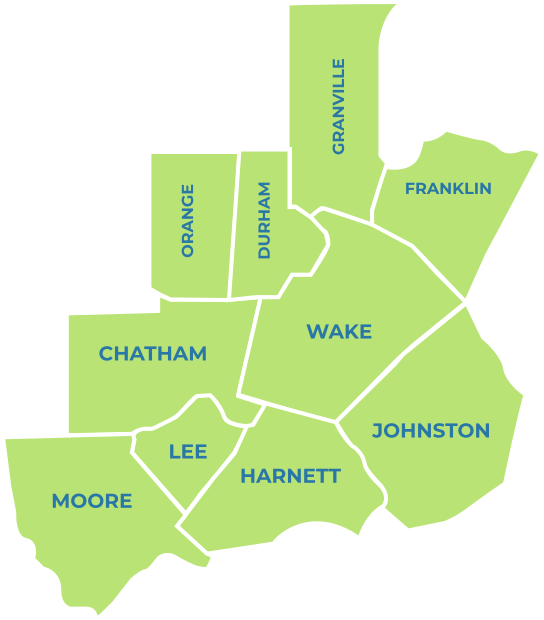
Serving the Triangle and surrounding counties for 25+ years
Wake County
RaleighApexGarnerFuquay-Varina Holly SpringsKnightdale Morrisville ZebulonWendellRolesvilleChatham County
ApexOrange County
Chapel HillDurham County
DurhamHarnett county
Lee county
Moore county
Franklin county
CHATHAM COUNTY
Johnston county
Not your typical divorce lawyers
We are here to help you succeed and protect what you value most.