Divorce Process in North Carolina
 Google Reviews

Divorce Process in North Carolina
No couple expects to get divorced, but for many, it’s the best course of action to ensure both spouses can live happier, more fulfilling lives. If you and your spouse have decided to end your marriage, it’s important to understand the divorce process and your options for dissolving your marriage.
Divorce From Bed and Board
In North Carolina, there are two types of divorce:
- Absolute divorce: The marriage is dissolved, and both spouses are free to remarry if they wish.
- Divorce from bed and board: This is not an official divorce but a court order authorizing separation. This order does not end your marriage or your rights from being married. You must obtain an absolute divorce to legally end a marriage.
In order to qualify for a divorce from bed and board, you must be able to prove that your spouse is at fault and that the fault was unprovoked. The accused spouse can also bring defenses against a divorce from bed and board. There are seven grounds for divorce for bed and board:
- Cruel treatment of a spouse
- Abandoning the family
- Maliciously turning the other spouse out of doors
- Adultery
- Indignities that make a spouse’s life overly burdensome or condition intolerable
- Excessive drug or alcohol use so as to render the condition of the other spouse intolerable and the life of that spouse burdensome
- Constructive abandonment
With a divorce from bed and board, the accused spouse loses some estate rights, such as:
- Right to inherit, unless stated otherwise in a will
- Right to cohabitation—the court may also award one spouse the marital residence
- Right to homestead
- Right to petition the court for an elective share of the estate
- Right to dissent from the other spouse’s will
- Right to administer the other spouse’s estate
The spouse filing the complaint, however, maintains those rights.
If the spouses decide to resume marital cohabitation after a divorce from bed and board has been issued, the divorce from bed and board is destroyed without further action from the Court. In this case, the accused spouse’s rights lost in the divorce from bed and board are restored.
To file for a divorce from bed and board, either you or your spouse must have lived in North Carolina for at least six months prior to filing the lawsuit and the grounds for the divorce from bed and board must have existed for at least six months prior to filing the lawsuit.
Divorce from bed and board is complicated and very different from an absolute divorce. Without bringing other marital claims, a divorce from bed and board does little more than establish marital fault for alimony purposes, authorize separation, and cut off certain estate rights. To understand your rights or the rights you stand to lose, it’s important to work with an experienced and knowledgeable divorce lawyer in North Carolina.
Grounds for Divorce
In North Carolina, the grounds for divorce are:
- Separation for 12 months: The couple must have lived in separate homes for one year with the intent of at least one spouse for the separation to be permanent. If either spouse moves back into the marital home at any time during this period, the separation period resets.
- Incurable insanity: Absolute divorce may be granted if spouses live separately for three years due to incurable insanity. It is not sufficient to just say your spouse is incurably insane. There must be medical proof that the spouse is incurably insane and has been for more than three years before filing for divorce.
Obtaining an Absolute Divorce
An absolute divorce is the legal dissolution of your marriage in North Carolina. Couples can obtain an absolute divorce if they have been separated for a period of at least one year and a day.
Additionally, one of the spouses must have intended to remain separated permanently during this time. It is irrelevant if this spouse expressed their intent to the other spouse.
One spouse will need to go to the Clerk of Court and file a complaint. It is preferred that the Court be in the county in which you reside or where your spouse resides. Of course, we file the complaint on behalf of our clients. Once the complaint is filed, the divorce process will include:
- The County sheriff will deliver the divorce notice, or it will be sent via certified mail or other allowed means
- The couple will remain separated for 12 months
However, if you move back in with your spouse at any time during the 12-month period, the calendar of 12 consecutive months will reset.
Mediation
If you and your spouse have issues to be resolved other than just the divorce itself, we recommend mediation. Filing for your marital claims for alimony, child support, child custody, and equitable distribution is only the start of the process. Once filed, you’ll need to either work out the details or go to Court for resolution, which can be expensive and time-consuming.
Mediation is a way to skip the lengthy court proceedings and allows you to:
- Streamline the process
- Save on costs
- Work on the division of assets together
- Look at custody schedules that make sense
- Examine cash flow for both households
When you go through mediation, you’re hammering out the final details of your separation and divorce in a less formal setting. Mediators can also help couples come up with a unique solution based on each spouse’s demands and preferences. In mediation, you are not limited in many ways by the North Carolina General Statutes, which the Court has to apply.
Final Orders
If you do not come to a final agreement on all your rights and responsibilities arising from your separation and divorce, the Court will get involved. The judge will hear testimony and arguments from both sides.
Next, the judge will decide what they believe is best for both parties. However, the judge will listen to the recommendations of each spouse’s attorney before making the final determination.
The divorce itself can be granted in North Carolina even if all your other issues and claims have not been resolved. That’s a bit unique to our State. Most states hold the divorce “hostage” until all the details of rights and responsibilities are worked out, either by you or by a Judge.
Finding the Best Cary Divorce Lawyer for You
Your divorce lawyer should:
- Specialize in North Carolina divorce proceedings
- Offer years of experience
- Encourage mediation if appropriate
If you need a lawyer, we can help. We have years of experience helping couples mediate their divorce and save money, time, and resources.
Call us today to talk to a divorce lawyer.
FILL OUT THE FORM BELOW AND WE WILL CALL YOU
Agreement Section 1
Agreement Section 1






What our clients say
"Across three states, Jenny was hands-down the best divorce lawyer I worked with! Authentic, savvy, insightful, tough, empathetic and effective. Can ’t say enough good things about her."

"The entire staff at Triangle Smart Divorce has been wonderful. My divorce has been extremely complicated and difficult, they have helped and been successful at every turn. They are more than competent and are also very compassionate individuals. They will and do walk you through each and every step to obtain the best results for you. An amazing team!"
"I would rate everything about my experience with Triangle Smart Divorce as 5 stars. The hardest step of any big decision is the first step. Jessica set the tone from the very first phone call. She was compassionate, calming and reassuring. The whole team has continued to work to maintain a supportive environment during the most difficult time of my life. I’m very grateful."
"Jenny Bradley and her team at Triangle Smart Divorce was the best decision I made. "
"Great firm! An outstanding group of professionals who are knowledgeable and care about their clients. I recommend Julianne and the firm to my clients and friends needing divorce and family law services."
"I felt heard, understood and listened to. Always there when I needed them! Had my best interest at heart and never let me down!"
"Outstanding firm. Try to work with their clients. Listens like a therapist. I am thoroughly pleased with the services I have been provided."
Meet Your Team
Our practice is entirely dedicated to helping couples move forward with confidence when dealing with divorce. You’re not alone.
Bradley
Bradley
LeFante
LeFante
Seagroves
Seagroves
rothert
rothert
O’Malley
O’Malley
stuntebeck
stuntebeck
Fillippeli
Fillippeli
Kober
Kober
Hodgins
Hodgins
Lester
Lester
Marks
Marks
Gardner
Gardner
Miller
Miller
Gokey
Gokey
Gagnon
Gagnon
Eakes
Eakes
Allen
Allen
Caling
Caling
Rosario
Rosario
Cayford
Cayford
Douglas
Douglas
Bigger
Bigger
Skelton
Skelton
Roakes
Roakes
Hartsell
Hartsell
Carlsten
Carlsten
Cazarez
Cazarez
Gardner
Gardner
Peele-Garcia
Peele-Garcia
Learning center
Want to know how to prepare for divorce? Use our free resources to guide you. Our mission is to get you to where you want to be — without years of legal fees, court battles and emotional damage.




Blog
All Blogs


Resources
All ResourcesFrequently Asked Questions
IS IT WORTH IT TO GET A DIVORCE LAWYER?
A divorce lawyer may seem like an extra expense if both parties agree on the big decisions, but the details of a divorce can be complex and hard to navigate without an expert, and getting the agreement properly written ensures that everyone has the security and clarity they need to move forward with their lives. It’s better to do it right the first time than have to keep going back and fixing mistakes. And, in some cases, you may not be able to fix your mistakes.
WHAT QUESTIONS SHOULD YOU ASK A DIVORCE LAWYER?
You should ask a potential divorce lawyer about their prior experience with cases like yours, their approach to negotiations when couples reach a disagreement, and their personal success rate in arriving at a resolution through negotiation and/or mediation.
WHAT CAN YOU NOT DO DURING A DIVORCE?
You cannot have one lawyer serve both parties in a divorce. This would be a conflict of interest. It’s incredibly important that each party feels their individual needs are represented and voiced, and that cannot be done with a single lawyer serving as the representative for both parties.
Top-Rated Divorce Lawyers
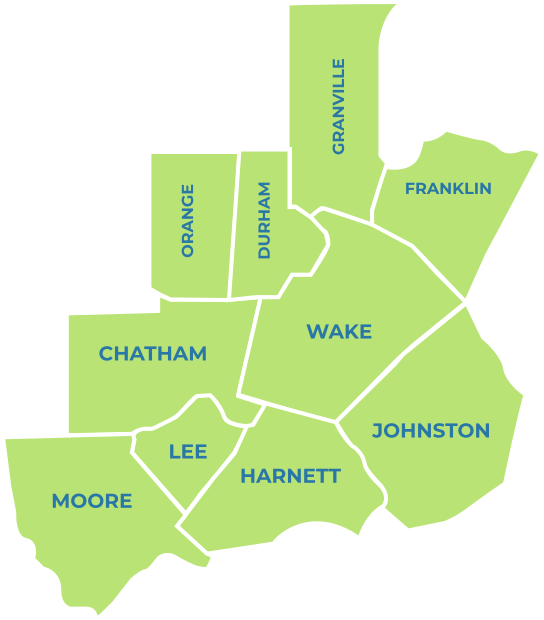
Serving the Triangle and surrounding counties for 25+ years
Wake County
RaleighApexGarnerFuquay-Varina Holly SpringsKnightdale Morrisville ZebulonWendellRolesvilleChatham County
ApexOrange County
Chapel HillDurham County
DurhamHarnett county
Lee county
Moore county
Franklin county
CHATHAM COUNTY
Johnston county
Not your typical divorce lawyers
We are here to help you succeed and protect what you value most.